Just 25 minutes north of Himeji City by train lies the town of Fukusaki. Surrounded by mountains with the Ichikawa flowing through it, it’s just far enough off the beaten path to feel like you’re in the countryside. And, well, you kind of are. Fukusaki is best known for producing mochimugi, or Japanese pearl barley, which has been cultivated here for many generations. But Fukusaki is also the hometown of the folklorist, Yanagita Kunio (1875-1962), and so it has come to be known as a yokai town.
In Japanese, yokai refers to a wide range of supernatural beings, including monsters, demons, spirits, goblins, and ghosts, but also transformed humans, animals, or objects. This is linked to animism, a common belief in Japan that is rooted in Shinto. It holds that all things, from mountains and rivers to pencils and potted plants, possess spirits or life forces, called kami. But yokai can also refer to urban legends or any strange, unexplained phenomena, so the term is quite broad.
So broad, in fact, that it’s possible to dedicate your entire life to studying yokai, which is exactly what Yanagita Kunio did. He started his career as a bureaucrat, but after developing an interest in the folk traditions of rural Japan, he decided to pursue that instead. This led to the establishment of Japanese folklore, or minzokugaku, as a new academic field, and so Yanagita is often called the father of Japanese folklore.
Yanagita was born and raised in Tawara Village, Tsujikawa, which is part of modern-day Fukusaki. In his memoir, Seventy Years in My Hometown, he details his childhood growing up in “Japan’s smallest” house. It still stands today, in what is now Tsujikawayama Park.


After graduating, Yanagita joined the Ministry of Agriculture and Commerce. Part of his work involved traveling across Japan for lectures and inspections, and in 1908, he visited the village of Shiiba in Miyazaki Prefecture. There, he was surprised to discover that traditional ways of living, including boar hunting and slash-and-burn farming, were still being practiced, despite Japan’s rapid modernization after the Meiji Restoration.
Soon after, he was introduced to Kizen Sasaki, another folklorist from Tono in Iwate Prefecture. Sasaki told him stories about kami andyokai from his hometown, which Yanagita recorded and later published as Tono Monogatari (The Legends of Tono). Considered a foundational text, it includes 119 stories that were later translated into English by Ronald A. Morse.
Yanagita went on to write many other books, including his 1956 collection, Yokai Dangi (Discussions of Yōkai), which helped popularize many yokai known today, including kappa, or water sprites. And in Fukusaki, where it all started, many of these yokai have been transformed into benches, which are dotted around Yanagita’s old neighbourhood and the center of town. This has created a fun scavenger hunt for visitors, on foot, by bicycle, or by car.
The adventure starts just outside Fukusaki Station, where the first bench is waiting right next to a tube, in which Gajiro, the town’s kappa mascot, pops up to welcome you. The bench features Amabie, a mermaid-type creature from Kumamoto that is said to cause phenomena like shining lights from the sea. It has a beak, scales, and three legs. Pretty cute for a monster, if you ask me.


I found the next bench, Tengu, not too far away, sitting appropriately outside a restaurant called Tengu Sushi. Tengu is one of the most well-known yokai, a creature believed to dwell deep in the mountains. Almost human-like in appearance, it has a long nose, red skin, large wings, and mystical powers. Strange happenings in the mountains were often attributed to tengu, which have been regarded as both gods and yokai.
About five minutes down the road is the Fukusaki Community Hall, where I spotted Yukionna. Also known as the Snow Woman, this yokai is found in cold regions dressed all in white. It’s said that she blows cold breath on men, causing them to freeze to death.
It was mid-morning by this point, so I decided to stop for a bite at a local cafe, which turned out to be a highlight of the trip. Ringonoki (Apple Tree) is an English rose garden-themed tea room with the most delicious coffee and homemade scones—truly, the best yet I’ve had in Japan. The owner makes the scones herself, and you can buy some to take home, along with other handmade sweets.
There’s also a small selection of clothing and jewelry from local artisans on sale, and the most adorable teapot collection to enjoy. It’s the kind of place you rarely find outside of small-town Japan.


After this little rest stop, it was time to head across the Kanzaki Bridge to the other side of town. Keep to the left side of the road for access to the pedestrian walkway. From here, you can enjoy stunning views of the river and the surrounding hills. Once you cross the bridge, it’s about a 10-minute walk straight down the road to the Tsujikawa Tourism Exchange Center.
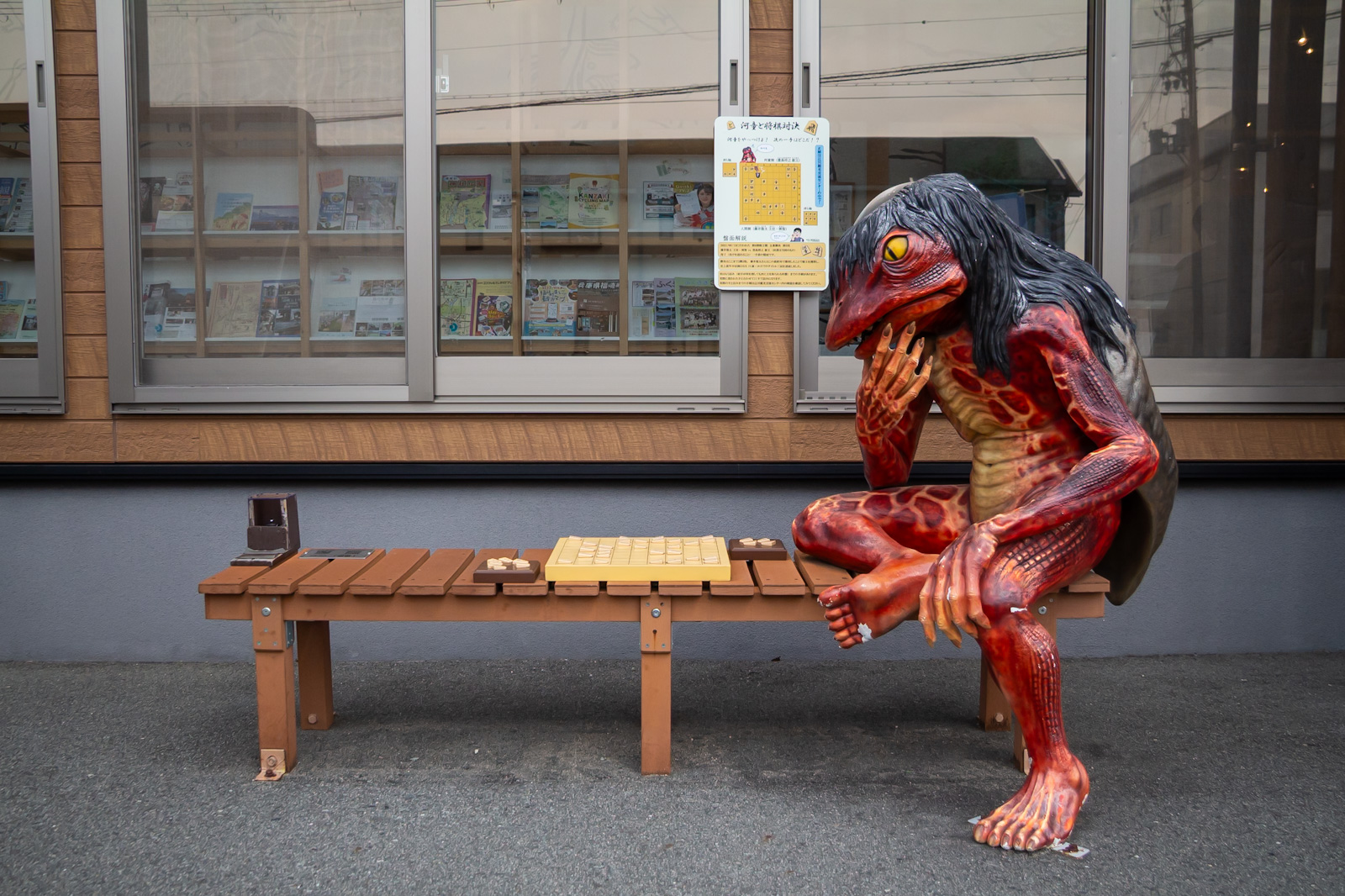
There are three yokai benches in this area: Kappa and Kuwazunyoubou outside the center, and Umibozu across the road in front of the Matsui Butcher. Umibozu is a sea ogre that attaches itself to boats. Sometimes, it will ask to borrow a ladle, and if you don’t give it one with a hole in the bottom, it will waterlog your boat.
Kuwazunyobo is a young and beautiful woman—at least, upon first glance. At the back of her head, she has a second mouth that uses strands of her hair to grab and shovel in food. She is also called Futakuchi–onna, or the Two-Mouthed Woman.
A kappa is a river sprite with a dish on its head that is believed to pull people into the water. Because of this, signs that prohibit swimming in Japan often feature kappa on them. In some legends, kappa steal their victims’ shirikodama, a mythical organ containing one’s life force located near the anus. If this happens, a person becomes weak and limp. Kappa are also known to love cucumbers and sumo wrestling.


Inside the Tsujikawa Tourism Exchange Center, you can get free English maps of the local area and rent a bicycle, if you prefer to tour the town that way. There’s also a small gallery of yokai art, gachapon (capsule toys) of the yokai benches, and a small gift shop and cafe. After picking up an English book on yokai (a rare find), I headed up to Tsujikawayama Park, which is just a five-minute walk away.
Tsujikawayama Park has two yokai benches nearby. One is at the entrance to the park—Aburasumashi—and the other is outside a soba noodle shop across the street—Zashikiwarashi. Zashikiwarashi is a child spirit that lives in rooms and storehouses. Entertaining a Zashikiwarashi is said to bring good fortune to a home, but if it disappears, the family will fail. Aburasumashi is a mysterious but harmless ghost that appears on mountain paths carrying a bottle of oil.
The park itself contains yokai sculptures rather than benches, including the famous kappa, Gajiro, and an Upside-Down Tengu. Gajiro emerges from the Kappa Pond every 0, 15, 30, and 45 minutes past the hour. The Upside-Down Tengu flies out of his hut every 5, 20, 35, and 50 minutes past the hour. The other yokai in the park are the winning entries of the National Yokai Sculpture Contest, which was held in Fukusaki between 2014 and 2018. You can also see the childhood home of Kunio Yanagita, and other buildings related to his family and the town’s history.


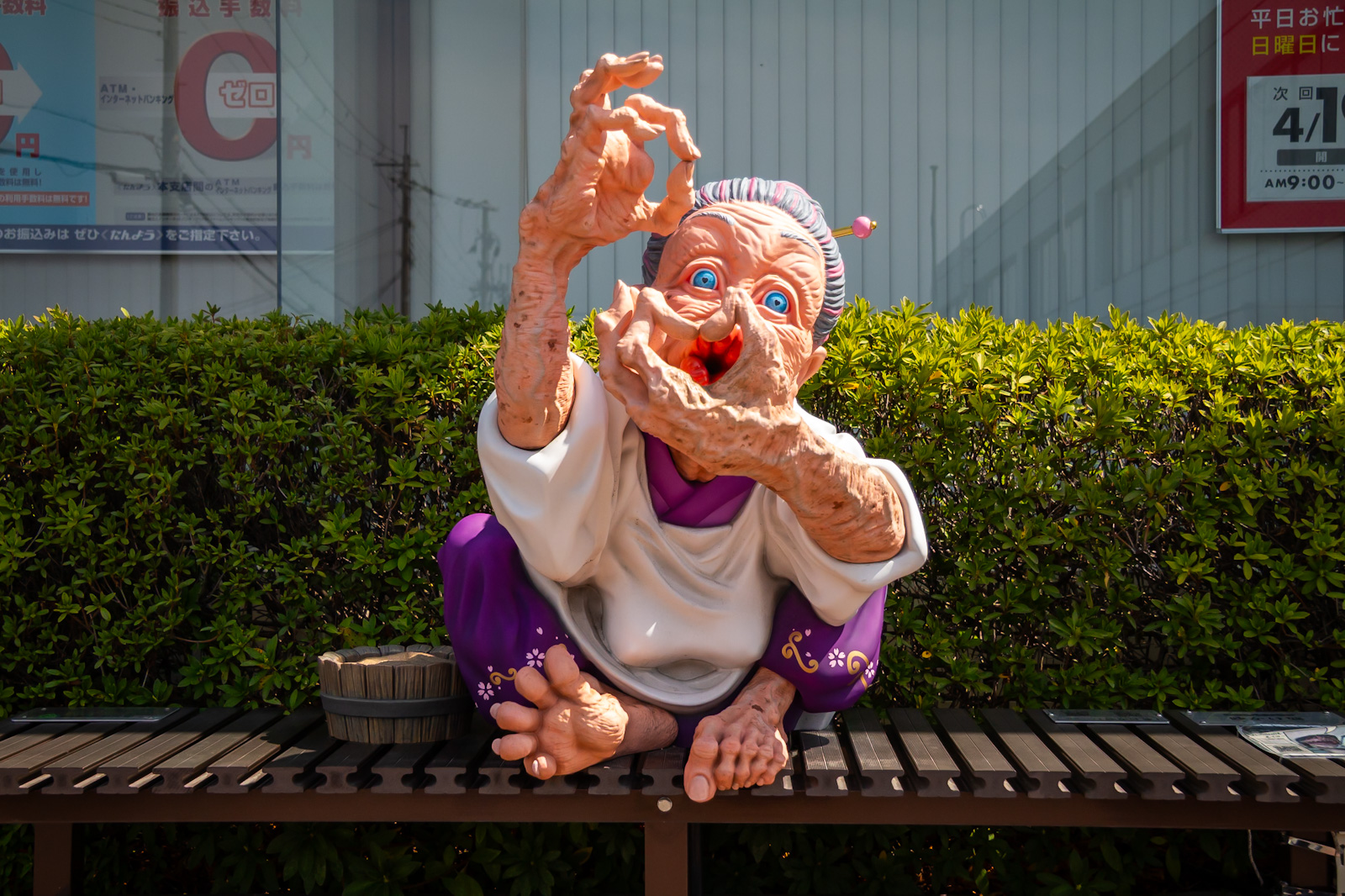
After exploring the park, I headed towards Fukusaki Town Hall for the next yokai bench, Sunakakebabaa. This creature takes the form of an old woman, who is said to frighten people passing by at night by throwing sand at them. Just a few blocks down the road, I found Aburabou outside a yakiniku restaurant. In times when oil was a precious commodity, stealing it was considered a serious crime, and those who did were believed to be transformed into such yokai as punishment.
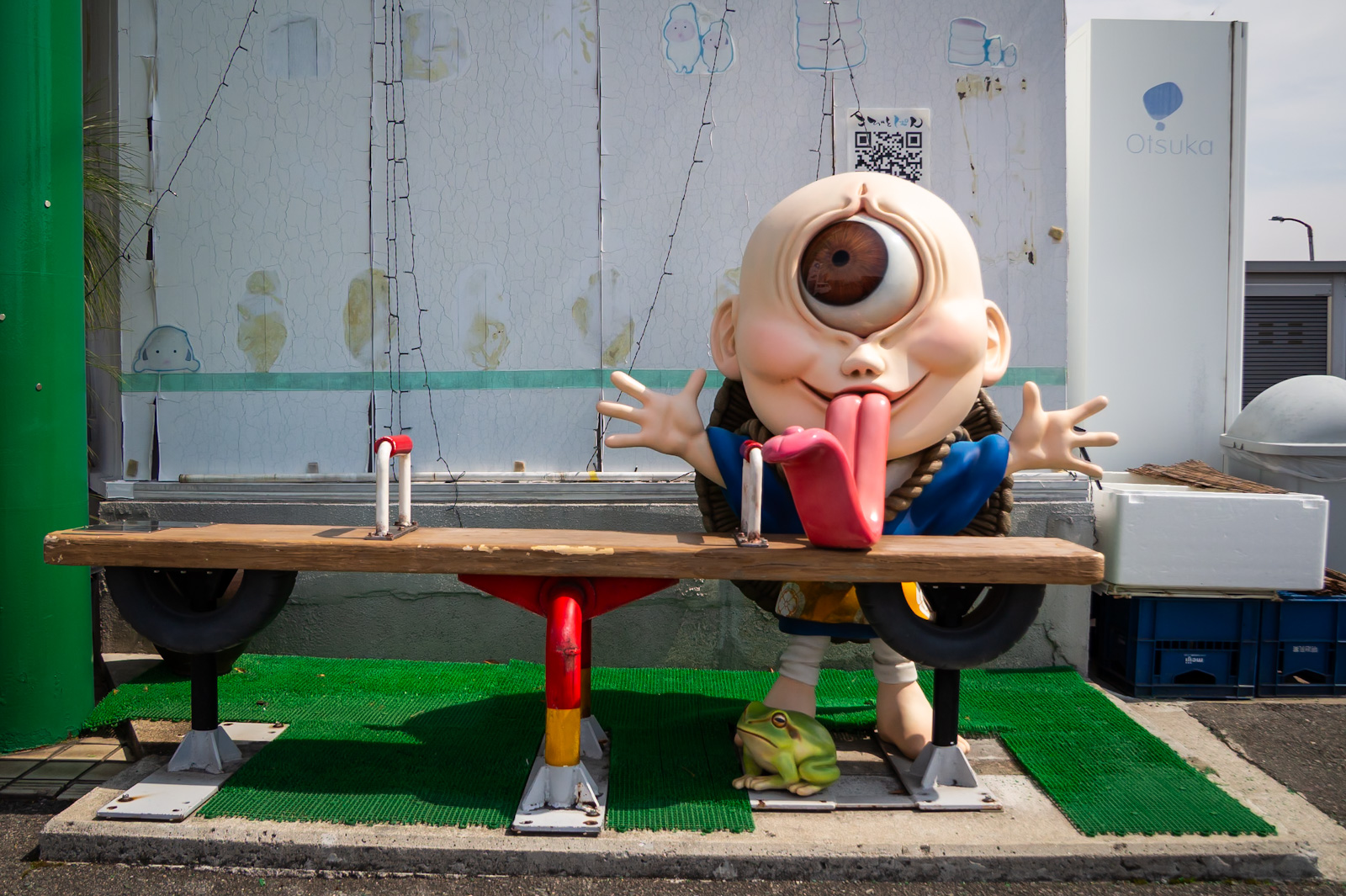
A little further down the road is a dessert shop and the Hitotsumekozo bench. This yokai has a single eye and takes the form of a monk. It’s known for playing pranks by suddenly appearing in front of people to startle them.
By this time, I was starting to feel pretty yokai-ed out, so I decided to head back to the station, passing Sunekosuri and Nekomata on the way. Nekomata is an old pet cat that transformed into a monster that sometimes attacks humans. It’s said to have a split tail and walk on two legs. The oldest record of Nekomata in Japan is in a book called Meigetsu-ki from the Kamakura period (1185–1333). Conversely, Sunekosuri is a dog-like yokai that rubs its way between people’s legs. It’s said to be a gentle ghost that often appears on rainy nights.
Back at the station, I discovered another information center, which has a bigger selection of yokai-themed gifts and mochimugi products. There’s also a small cafe, serving things like coffee and barley ice-cream, where you can take a rest before heading back to Himeji.


In the end, I managed to see 13 of the 22 yokai benches—not bad for a half day of walking, I thought, especially since I managed to do the park as well. Of course, if you bike or drive around town, it’s much easier to see everything, as some are a bit further out. There’s also a stamp rally, where you can collect a layered stamp from 10 of the benches.
All of this info is on the Yokai Bench Search Map available from the tourism exchange center, or you can use my map below. Everything pinned in blue and purple is what I managed to see in 4 hours on foot (not counting the time I spent at the cafe), listed in order of places visited. I’ve also pinned the benches I didn’t see, for reference, in green.
Less than half an hour from Himeji Station, Fukusaki is a fun little side quest if you happen to be visiting the area. It’s also easy to reach from major cities, like Osaka, Kobe, Okayama, and Hiroshima, via the Shinkansen, making it a great day trip option. If you’re interested in yokai and/or seeing a different side of Japan, I highly recommend checking it out.
Visit Fukusaki
JR Fukusaki Station is 25 minutes by train from JR Himeji Station on the Bantan Line. For more information, visit the Fukusaki Town Tsujikawa Tourism Exchange Center.